Evidence in a Personal Injury Claim: Records, Photos, Video, and Expert Analysis
Evidence in a personal injury claim includes medical records, accident photos, video, witness accounts, and expert analysis that connect the incident to fault and the injury. Atlanta Auto Law reviews, organizes, and uses those materials to develop a claim.
Written by Ronnie Mabra
Request an EstimateWhat Evidence Do You Need for a Personal Injury Claim?
Evidence in a personal injury claim should show what happened, who was responsible, what injury resulted, and how the injury affected the claimant.
We organize the proof around negligence, liability, causation, and damages. This evidence-to-claim map helps us connect the accident scene to the medical treatment and financial losses.
Useful case materials may include records, photographs, video, witness testimony, and expert analysis. Together, these materials can help prove fault, document injuries, establish causation, and support the value of the claim.
Our team handles the legal review through Personal Injury Claims, including the relationship between responsible conduct and the losses that followed.
Written by Ronnie Mabra.
Which Records and Materials Can Support Your Claim?
Claim documentation can support liability, causation, and damages when each record is tied to a specific part of the incident or loss. We collect the available materials and compare them for consistency.
These materials may come from different sources, so dates and descriptions matter. We organize them with photographs, video, and other proof to support a complete claim investigation.
How Do Medical Records Help Prove an Injury Claim?
Medical records help prove an injury claim by documenting the diagnosis, treatment, symptoms, and medical connection between the incident and the injury.
A healthcare provider’s records can show when symptoms began, what the examination found, and how the diagnosis changed over the course of care. Treatment history can also show whether follow-up care was needed.
We compare the medical documentation with the incident account and other evidence. This review helps address medical causation, including whether the records support a connection between the event and the claimed injury.
Medical bills add financial proof, while treatment notes may explain pain, restrictions, and the need for continued care. Those records can support both economic damages and noneconomic damages such as pain and suffering.
What Can Photos, Video, and Dashcam Footage Show?
Photos and video can preserve conditions, conduct, injuries, and timing that may support or challenge the parties’ accounts.
The value of visual evidence depends on what it shows and whether its source can be explained. We review the original files, available video metadata, and the chain of custody when authenticity or timing may be disputed.
| Evidence | What it may show | What we review |
|---|---|---|
| Accident scene photos | Road conditions, traffic controls, vehicle positions, and visible hazards | Location, perspective, timing, and consistency with other evidence |
| Injury photographs | Visible changes and the condition of an injury | Date, source, context, and relationship to medical records |
| Property damage images | Damage location, severity, and collision contact points | Vehicle damage and consistency with the reported collision |
| Surveillance footage | Conduct, movement, scene conditions, and events before or after an incident | Who controls the recording, preservation, and completeness |
| Dashcam footage | Traffic movement, vehicle positioning, and collision timing | The original video file, metadata, and whether the footage is continuous |
| Traffic camera footage | A broader view of traffic flow and roadway events | Availability, source, time reference, and chain of custody |
Yes, surveillance or dashcam footage can be used in a personal injury claim when it is relevant and can be authenticated. We work to identify who controls the recording and preserve evidence before it is overwritten or altered.
How Should You Preserve Evidence After an Accident?
Evidence preservation protects original information and helps prevent later disputes about what a record, image, or recording contained.
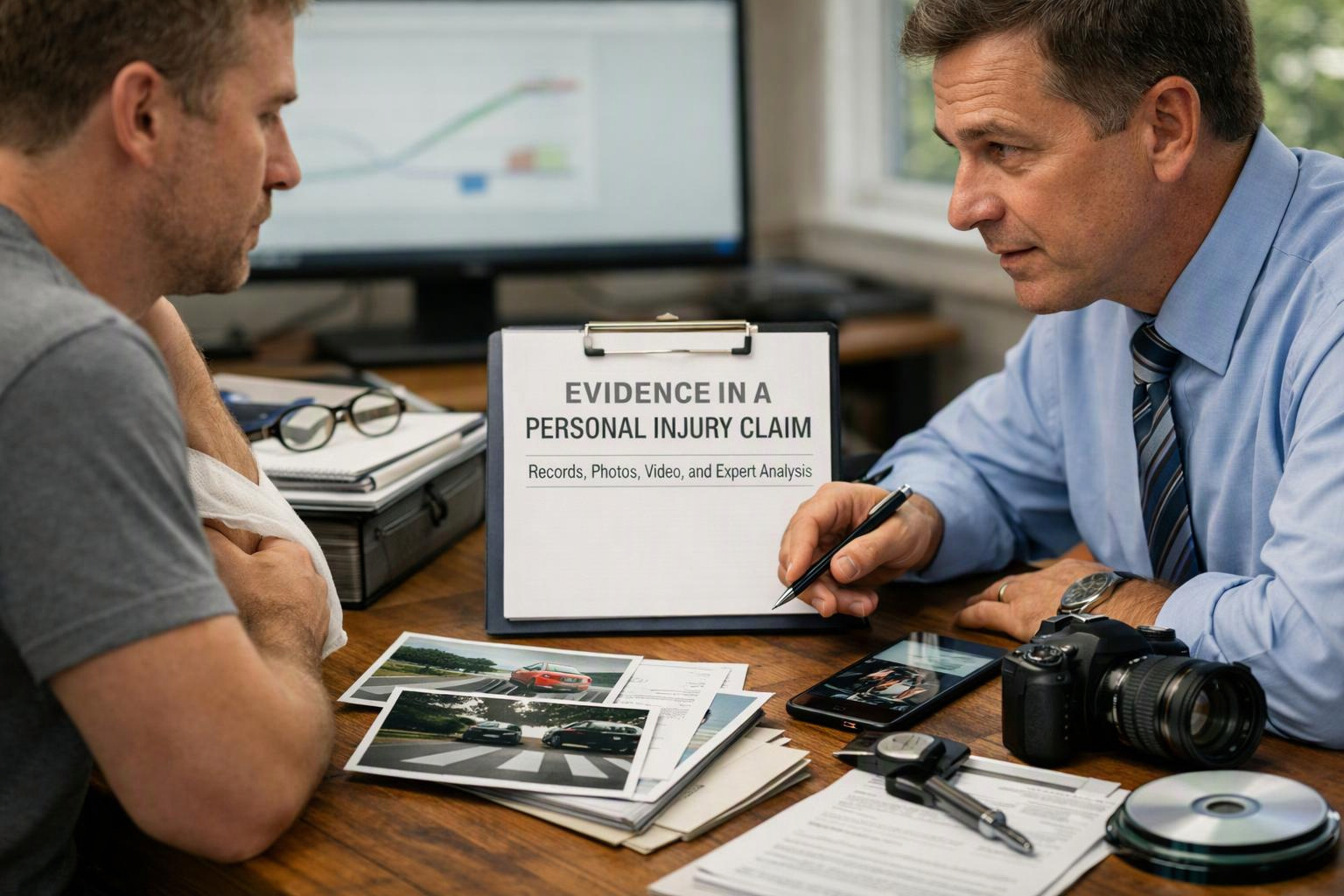
Do not alter, crop, overwrite, or delete potentially relevant evidence. We help identify what should be preserved and how each item may fit into the claim.
What Does an Accident Reconstruction Specialist Do?
An accident reconstruction specialist analyzes physical evidence and collision dynamics to explain how an accident occurred and whether the evidence supports a party’s account.
Our team may review vehicle damage, scene evidence, skid marks, vehicle positioning, and available records. Speed analysis and other collision dynamics can help explain movement before, during, and after impact.
The resulting expert analysis may clarify disputed liability or challenge an explanation that does not match the physical evidence. When appropriate, an expert report can support expert testimony during settlement discussions or litigation.
Accident reconstruction is most useful when the event sequence, vehicle movement, or fault is contested. We connect the technical findings to the witness statements, photographs, video, and medical proof.
How We Evaluate and Organize Evidence for a Claim
Atlanta Auto Law evaluates evidence by connecting the incident, responsible conduct, medical proof, and financial losses into a coherent claim.
We begin with a case evaluation that identifies the key questions about negligence and liability. Our team then compares witness evidence, reports, photographs, video, and physical proof to determine whether the accounts align.
Medical documentation helps us connect the incident to the injury and the treatment that followed. Damages documentation helps show medical bills, lost income, property damage, and the effect of pain and suffering.
When the facts require technical interpretation, we consider expert analysis such as accident reconstruction. The goal is a clear claim presentation that explains fault, causation, injury, and damages without leaving important gaps.
Our approach applies to Personal Injury Claims and Car Accident Claims where evidence must support both liability and the losses being requested.
When Should You Contact Atlanta Auto Law About Evidence?
Contact Atlanta Auto Law when evidence may be lost, disputed, controlled by another party, or needed to explain the cause and value of an injury claim.
Early legal review can help protect relevant records and frame the facts before an insurance adjuster relies on an incomplete account. We assess what the evidence shows and how it supports the claim.
Questions About Evidence in a Personal Injury Claim
Can deleted or unavailable surveillance footage still matter in a personal injury claim?
Atlanta Auto Law can still evaluate deleted or unavailable surveillance footage when other evidence may show that a recording existed or should have been preserved. We look at requests for the footage, control of the recording system, witness accounts, and whether the loss affected the claim.
Can social media posts affect a personal injury case?
Yes, social media posts can affect a personal injury case when they appear to conflict with claimed injuries, limitations, or losses. Preserve relevant content and avoid deleting or changing posts because those actions can create additional questions about the evidence.
What happens if the other driver disputes how the accident happened?
A disputed accident account is tested against photographs, video, vehicle damage, scene evidence, witness statements, and available reports. We compare those sources and may use accident reconstruction or other expert analysis when physical evidence is needed to explain the collision.
Can a police report prove who was at fault?
A police report can provide useful observations and statements, but the report alone may not prove liability in every personal injury claim. We compare it with witness testimony, photographs, video, physical evidence, and medical records.
How can witnesses support a personal injury claim?
Witnesses can support a personal injury claim by describing what they personally saw, heard, or observed before and after the incident. Their contact details and statements can help clarify traffic movement, conduct, scene conditions, and the immediate effects of an injury.
Atlanta Auto Law reviews the available proof, preserves important evidence, and builds the connection between liability, causation, injury, and damages.